Viking Appliance Diagnostic Code Repair Insights
Viking appliance error codes usually make more sense when they are connected to the way the appliance is behaving in the kitchen, not just to the message on the display. For many homeowners in Waltham and nearby Massachusetts communities, the first real sign of trouble is not the code itself. It is the change in operation around it. An oven may stop heating correctly, fail to complete a function, or respond poorly to commands. A dishwasher may interrupt the cycle because it detects too much water or a leak-related condition. A refrigeration unit may warn that one section is running too warm, too cold, or no longer reading temperature correctly.
That is why a Viking error code is usually best read as a system warning rather than a final diagnosis. In most cases, the alert does not identify one exact failed part. It points to the operating area where the appliance is no longer performing normally, such as temperature sensing, probe feedback, latch behavior, keypad communication, model configuration, water-level protection, cooling performance, or refrigeration sensor feedback.
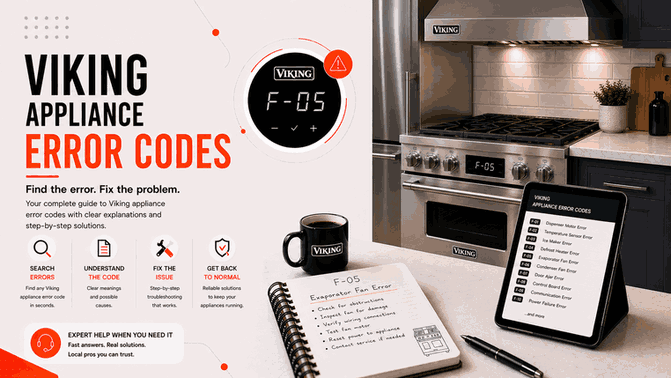
Why Viking Alerts Usually Matter Most When Cooking or Cooling Functions Stop Feeling Precise
With Viking appliances, a warning often becomes important when the appliance no longer handles normal kitchen tasks with the consistency a homeowner expects. A sensor-related code matters more when heating becomes unreliable. A latch-related message matters more when the appliance cannot complete a function correctly. A dishwasher protection code matters more when the unit stops because excess water or a leak condition may be present. A refrigeration warning matters more when stored food is exposed to unstable temperatures or when the unit keeps reporting the same cooling condition.
That is why repeated alerts deserve attention. Once the same warning keeps returning and the appliance continues acting abnormally, the issue is usually affecting more than convenience. It is often a sign that the control, sensing, or protection system behind the alert has not returned to normal operation.
Viking Oven Diagnostic Codes
Viking Oven Codes That Can Affect Heat Control, Probe Response, or Command Reliability
The main Viking oven family in your file is built around sensor, probe, latch, and control-related faults:
Viking Oven Sensor, Probe, Latch, and Control Codes
MODEL ERROR / RTD ERROR / PROBE ERROR / LATCH ERROR / KEYBOARD ERROR
This group is important because it covers several key operating systems. These alerts usually point to an incorrect control configuration, an open or shorted oven temperature sensor, a meat-probe circuit problem, a latch mechanism fault, or a missing connection between the keypad and the control. In everyday home use, that may show up as an oven that does not heat correctly, will not complete certain cooking functions, or does not respond normally to commands.
For many homeowners, these alerts become more meaningful when they appear together with poor or unstable heating, interrupted cooking cycles, latch-related trouble, or probe-related warnings that affect normal use. Because Viking cooking appliances depend on accurate temperature feedback and reliable control communication, repeated alerts in this group usually mean more than a brief interruption.
Viking Dishwasher Diagnostic Codes
Viking Dishwasher Codes That Often Point to Overfill or Leak Protection
For Viking dishwashers, the main code in your file is:
Viking Dishwasher Overfill or Leak Protection Code
E:01
This alert usually points to too much water entering the machine or a leak condition being detected. In real household use, that may look like interrupted operation, visible water where it should not be, or a dishwasher that stops to protect itself instead of continuing the cycle.
Even though this code section is shorter, it is still important because protection-related warnings often appear when the dishwasher is trying to prevent a larger water-handling problem. For homeowners, that makes E:01 more than a simple display message. It is usually a sign that the appliance has detected a condition that should not be ignored, especially if the same warning returns after restart.
Viking Chill Refrigeration Diagnostic Codes
Viking Chill Refrigeration Codes That Usually Point to Temperature or Sensor Problems
Viking Chill refrigeration alerts are usually connected to temperature stability, section-specific cooling performance, or sensor feedback. The most relevant messages in this group include:
Viking Chill Temperature, Sensor, and Service Alerts
Lower unit too warm / Lower unit too cold / Lower too warm / Lower too cold / Upper too warm / Upper too cold / Call Service / High Temp Error / Sensor failure alarm / HH / LL / Error Code...
These alerts matter because refrigeration warnings often affect more than appliance convenience. A message such as Lower unit too warm, Upper too warm, or High Temp Error may point to a compartment that is not staying within the expected temperature range. A warning such as Lower unit too cold, Upper too cold, HH, or LL may suggest abnormal temperature readings or cooling behavior that needs closer diagnosis. A Sensor failure alarm usually means the appliance may not be receiving reliable temperature information, while Call Service is a broader warning that the control system has detected a condition that should be checked professionally.
In everyday use, these codes may appear with food that feels warmer than expected, items freezing in the wrong section, unusual cycling, inconsistent compartment temperatures, or a display that keeps returning to the same warning. Homeowners can safely check whether the doors are fully closed, whether airflow is blocked by overloaded shelves, and whether the temperature setting was changed accidentally. If the same refrigeration alert comes back, especially with temperature-sensitive food inside, the safer next step is in-home diagnosis rather than repeated resets.
How Waltham Homeowners Should Read Viking Codes in Real Use
The most useful first step is to compare the code with the actual performance of the appliance. For an oven, look at whether the unit is heating normally, completing functions correctly, recognizing probe input, or responding to keypad commands the way it should. For a dishwasher, look at whether the cycle is stopping unexpectedly, whether excess water may be present, or whether the machine appears to be entering protection mode. For refrigeration, look at whether one section is too warm, too cold, cycling unusually, or showing repeated sensor or high-temperature warnings.
This kind of safe observation gives a clearer picture of whether the alert was temporary or whether the appliance is showing a repeated operating problem that still needs attention.
When Repeated Viking Codes Usually Need In-Home Diagnosis
Repeated Viking error codes often mean the appliance is still dealing with a deeper sensing, control, latch, cooling, or protection-related issue even if it powers back on. The same warning returning is often the clearest sign that the system behind it has not gone back to normal.
For homeowners in Waltham and nearby Massachusetts communities, in-home diagnosis helps connect the code to the real appliance behavior affecting everyday kitchen use. Fast Fix Appliance Repair provides local in-home service with a focus on safe workmanship, careful diagnostics, clear communication, and warranty-backed repair results.
Contact Information
Fast Fix Appliance Repair – Waltham MA
📍 Address: 14 Middlesex Rd, Waltham, MA 02452
📧 Email: fastfixapplianceservice@gmail.com
☎️ Phone: +1 (508) 733-3351
🕒 Open Hours: 8:00 AM – 8:00 PM
Viking Appliances Error Codes Table with Appliance Types, Meanings, and Service Notes
This Viking appliances error code table shows each Viking fault code by appliance type, listed meaning, first check, technician service note, and related help when available. It includes Viking oven, dishwasher, and Chill refrigeration error codes, so each display warning can be matched with the correct table row and reviewed with Viking’s official Product Documentation and Support FAQs resources.